
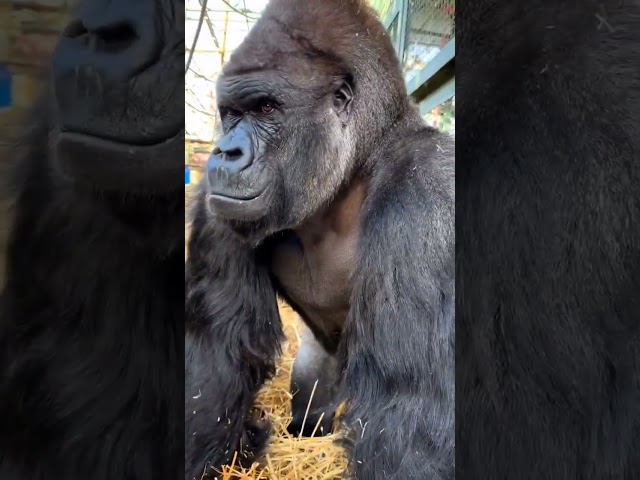
Rewilded Silverback Gorilla, Djala, Turns 40: A Triumph of Conservation and Resilience
Introduction
In the heart of Africa’s dense rainforests, a remarkable silverback gorilla named Djala celebrates his 40th birthday—a milestone that symbolizes not just longevity, but an extraordinary journey from captivity to freedom. Djala’s story is one of hope, resilience, and the power of rewilding, proving that even animals born in captivity can reclaim their wild instincts.
This article explores Djala’s life, his successful rewilding, and what his story means for gorilla conservation worldwide.
Chapter 1: Djala’s Early Life – Born in Captivity
1.1 A Gorilla Without a Wilderness
Djala was born in 1984 in a European zoo, far from the lush forests of Central Africa where western lowland gorillas naturally thrive. Unlike wild gorillas, who grow up learning survival skills from their troop, Djala’s early years were spent behind glass, dependent on human caretakers.
1.2 The Challenges of Captive Gorillas
Limited social structure (unlike wild gorilla families)
Dependence on humans for food
Lack of natural behaviors (foraging, territorial patrolling)
Despite these limitations, Djala showed intelligence and curiosity, traits that would later help him adapt to the wild.
Chapter 2: The Bold Decision – Rewilding Djala
2.1 The Vision of Conservationists
In the early 2000s, a team of primatologists and conservationists proposed an unprecedented experiment: rewilding Djala. The goal? To see if a captive-born gorilla could relearn natural instincts and survive in the wild.
2.2 The Preparation Process
Before release, Djala underwent:
Gradual exposure to wild foods (fruits, leaves, termites)
Socialization with other gorillas (to mimic wild troop dynamics)
Survival training (nest-building, avoiding threats)
2.3 The Release – A Leap of Faith
In 2008, Djala was transported to the Lesio-Louna Reserve in the Republic of Congo, a protected area with a stable gorilla population. The first months were critical—would he adapt or struggle?
Chapter 3: Djala’s Triumph – Becoming a True Silverback
3.1 Learning from Wild Gorillas
At first, Djala observed other gorillas from a distance. Slowly, he:
Learned to forage by mimicking them
Built his first nest (a key survival skill)
Became more independent from human support
3.2 Rising in the Hierarchy
By 2012, Djala had integrated into a wild gorilla group. His strength and calm demeanor earned him respect, and eventually, he became a silverback leader—protecting his troop and even siring offspring.
3.3 A Symbol of Successful Rewilding
Djala’s journey proved that:
Captive gorillas can regain wild instincts
Rewilding is possible with proper preparation
Conservation efforts can restore lost behaviors
Chapter 4: Djala at 40 – A Living Legend
4.1 A Rare Milestone
Wild gorillas rarely live past 35-38 years, making Djala’s 40th birthday a testament to his resilience and the safety of his reserve.
4.2 His Legacy in Conservation
Inspired similar rewilding projects for other captive gorillas
Proved that zoos can contribute to wild reintroduction
Raised awareness about gorilla protection
4.3 Celebrating Djala’s Birthday
Conservationists and local communities celebrated his birthday by:
Planting fruit trees in his habitat
Monitoring his health (he remains strong and active)
Sharing his story globally to promote gorilla conservation
Chapter 5: The Future of Gorilla Rewilding
5.1 Lessons from Djala’s Success
Early preparation is key
Gradual reintroduction works better than sudden release
Wild gorillas can "teach" captive ones
5.2 Challenges Ahead
Habitat loss still threatens gorillas
Not all captive gorillas can be rewilded (some are too habituated to humans)
Funding and protection efforts must continue
5.3 How You Can Help
Support gorilla sanctuaries and rewilding programs
Avoid products linked to deforestation (palm oil, illegal logging)
Spread awareness about gorilla conservation
Conclusion: Djala’s Unforgettable Journey
Djala’s 40th birthday is more than a celebration of age—it’s a victory for wildlife conservation. His story shows that even animals born in captivity can rediscover their wild souls.
As we honor Djala, we must also commit to protecting his species, ensuring that future generations of gorillas have a home in the wild—just as he found his.



.jpg)


